Why Material Selection Matters for Food-Contact Components
Selecting the right stainless steel grade for food processor components ensures food safety compliance, structural strength, corrosion resistance, and sharp cutting performance. Different component types—such as rotating cutting discs, high-speed chopping blades, deep drawn housings, and perforated filter screens—require distinct balances of hardness, formability, and chemical stability under repeated washing and contact with acidic food substances.
In food appliance engineering, no single stainless steel grade suits every part. A chopping knife requires high hardness to hold a sharp cutting bevel, whereas a deep drawn bowl demands extreme ductility and corrosion resistance. Sourcing teams and product designers must match each component's mechanical function with the appropriate stainless steel alloy.
304 Stainless Steel (Austenitic)
Grade 304 (UNS S30400 / EN 1.4301, commonly known as 18/8 stainless steel) is the most widely utilized austenitic stainless steel in food processing equipment and commercial kitchen appliances. It contains approximately 18% chromium and 8% nickel.
Key Characteristics:
- Superior Corrosion Resistance: Excellent resistance to organic acids, food juices, detergents, and humid washing environments.
- High Ductility & Formability: Outstanding elongation properties make 304 the premier material for multi-stage deep drawing, complex stamping, and edge flanging.
- Non-Magnetic: Non-magnetic in the annealed condition (may exhibit mild magnetic response after severe cold working).
Typical Component Applications: Deep drawn food bowls, blender housing shells, precision filter baskets, juice strainers, bracket mountings, and non-cutting structural food-contact covers.
Limitation: Grade 304 cannot be hardened by standard thermal heat treatment. While it can work-harden under cold stamping, it cannot achieve the edge retention necessary for heavy-duty food slicing knives or high-speed chopping blades.
420 Stainless Steel (Martensitic)
Grade 420 (UNS S42000 / EN 1.4021 / 1.4028) is a martensitic stainless steel containing a higher carbon content (0.15% to 0.40%) and 12% to 14% chromium. It is the industry standard alloy for cutlery, surgical tools, and appliance cutting blades.
Key Characteristics:
- Heat-Treatable Hardness: Can be hardened through precision quenching and tempering to achieve high Rockwell hardness (HRC), providing exceptional wear resistance.
- Razor-Sharp Edge Retention: Maintains a keen ground or serrated cutting bevel under repetitive impact cutting of firm vegetables, meat, ice, and fibrous produce.
- Magnetic: Martensitic structure makes 420 magnetic in all conditions.
Typical Component Applications: Stainless steel cutting blades, S-shaped food chopper knives, blender blade assemblies, food slicer knife inserts, and meat grinder cutter plates.
Limitation: Lower corrosion resistance than austenitic 304. To prevent surface discoloration, components made from 420 must undergo rigorous passivation and post-heat-treatment polishing.
430 Stainless Steel (Ferritic)
Grade 430 (UNS S43000 / EN 1.4016) is a ferritic, straight-chromium stainless steel alloy containing 16% to 18% chromium with minimal nickel content. It provides a balanced combination of mechanical strength, formability, and cost economy.
Key Characteristics:
- Cost-Effective Stamping Performance: Lower raw material cost due to the absence of nickel, while offering good blanking, punching, and stamping ductility.
- Moderate Corrosion Resistance: Resists atmospheric corrosion, water, mild soaps, and weak food acids encountered in everyday kitchen processing.
- Magnetic & Rigid: Offers higher yield strength and thermal stability than annealed 304.
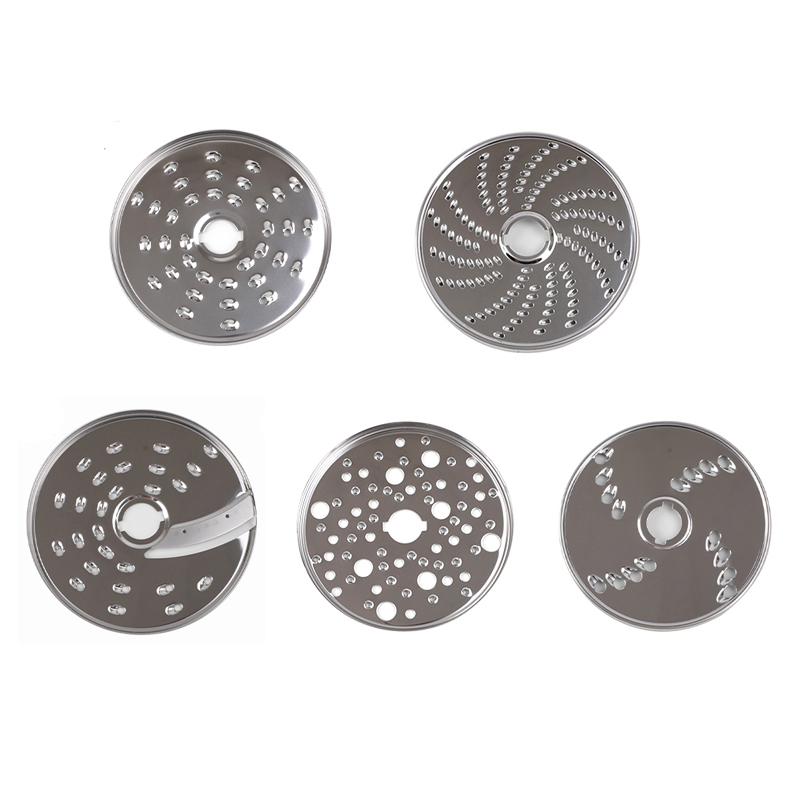
Typical Component Applications: Large food processor disc backing plates, shredder disc bodies, grater plates, appliance trim, and motor support brackets.
Application Note: Rather than labeling 430 as simply "better or worse" than 304, engineering teams specify 430 for large circular discs because it provides rigidity and economical high-volume stamping, while cutting knife inserts made from 420 are mechanically staked or riveted onto the carrier disc.
304 vs 420 vs 430 — Key Differences Comparison Table
| Property / Grade | Grade 304 (Austenitic) | Grade 420 (Martensitic) | Grade 430 (Ferritic) |
|---|---|---|---|
| Corrosion Resistance | High (Excellent against food acids) | Moderate (Requires passivation) | Good (Mild environments) |
| Hardening Capability | Cold work only (No heat hardening) | High (Quench & temper hardened) | Non-hardenable by heat treat |
| Formability & Drawing | Superior (Deep drawing & bending) | Moderate (Best in annealed blanking) | Good (Stamping & shallow forming) |
| Magnetic Response | Non-magnetic (Mild if cold worked) | Magnetic | Magnetic |
| Primary Role in Food Processors | Drawn bowls, filter mesh, housings | Chopping blades, slicing knife inserts | Disc carrier plates, shredding bodies |
Which Stainless Steel Is Suitable for Food Processor Components?
When selecting the material grade for a food processor part, consider the following functional factors:
- Component Function: Cutting edges requiring wear resistance mandate SUS420. Deep drawn or chemically etched strainers require SUS304. Large stamped base plates frequently utilize SUS430 or SUS304.
- Food Contact & Hygiene Standards: Parts in direct contact with acidic liquids, citrus, or dishwashing detergents benefit from the high nickel content of SUS304.
- Forming vs. Cutting Trade-off: Intricate multi-draw shapes require the high elongation of 304, whereas high-speed rotating knives require the hardness of 420.
- Manufacturing Cost: Optimizing materials across a multi-component assembly (e.g. 430 disc carrier with 420 cutting insert) provides performance while controlling bill-of-materials costs.
OEM Material Selection & Custom Manufacturing at Shengyue
At Dongguan Shengyue Metal Products Co., Ltd., we manufacture custom food processor parts and cutting assemblies according to customer CAD drawings, physical samples, and technical specifications. Our engineering team reviews your application requirements to evaluate:
- Optimal stainless steel grade selection (SUS304, SUS316, SUS420, SUS430, SUS301).
- Tooling design for progressive stamping, deep drawing, and precision edge beveling.
- Post-treatment processes including precision heat treating, ultrasonic cleaning, and chemical passivation.
Discuss Your Stainless Steel Component Project
Send your drawing, sample or material specification to our engineering team for manufacturing evaluation.
REQUEST A MATERIAL EVALUATION → WHATSAPP INQUIRY →