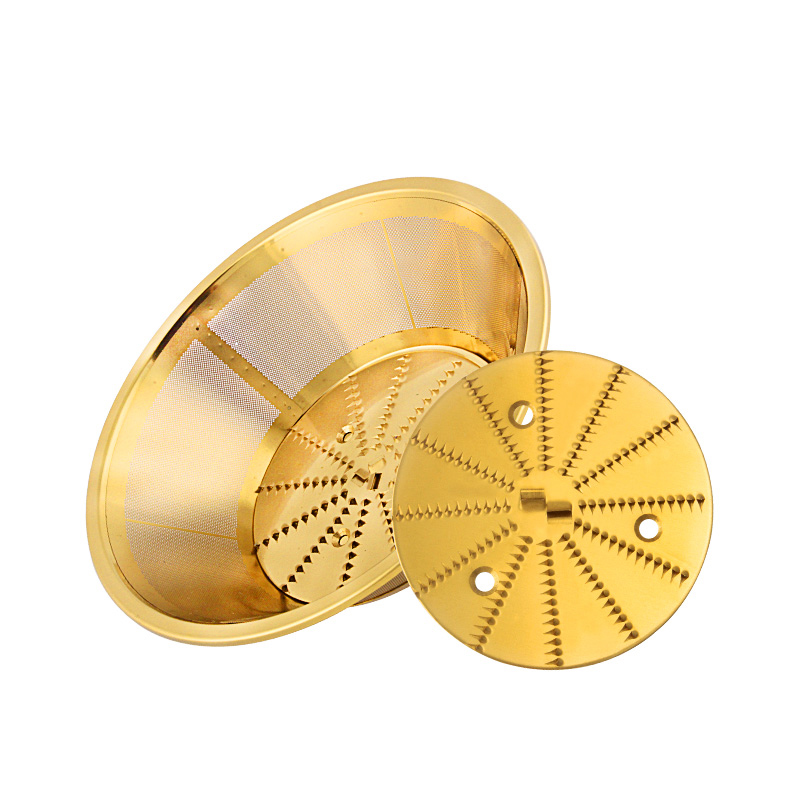
A juicer filter basket combines a perforated filtering surface with a formed body, rim and appliance interface. For OEM buyers, the important question is not only how the holes are made, but how the perforated material is formed and joined without losing the required shape. Chemical etching, deep drawing, edge flanging and laser welding can each play a role when supported by the approved design.
This guide explains the process logic behind a stainless steel filter project and links to Shengyue’s juicer filter basket and precision stainless steel filter components pages.
Why Chemical Etching Is Considered
Chemical etching removes material according to a prepared pattern. For filter components, it can be considered when the project requires a defined perforation layout and a controlled opening pattern. The pattern, material and application requirements must be confirmed before the supplier can recommend the route.
Etching is not a universal substitute for every perforated part. The basket shape, sheet condition, hole geometry, edge requirements and downstream forming operations all influence the feasible process. A drawing or sample gives engineering the information needed to review these interactions.
SUS304 Stainless Steel for Filter Programs
SUS304 stainless steel is commonly specified by customers for kitchen and food-processing components, including juicer filter baskets. The actual grade, thickness, surface condition and food-contact requirements should be stated in the project documentation. A supplier should not assume a grade from a product photo alone.
Food-Safety Inspection
Food safety inspection requirements should be agreed with the customer and evaluated against the intended application. This may include material documentation, surface review, cleaning considerations and inspection records required by the program. Shengyue confirms the applicable inspection scope during project review rather than presenting unsupported certification claims.
Deep Drawing the Basket Shape
After the perforated material is prepared, deep drawing may be used to form a bowl, cup or cylindrical filter body where the approved design calls for it. Drawing changes a flat sheet into a deeper shape while the tooling controls the profile. The forming sequence depends on the material behavior, depth, rim and interface requirements.
For complex formed parts, the related deep drawing components program provides a broader view of bowls, cups and other formed stainless steel parts.
Edge Flanging and Rim Formation
Edge flanging creates or adjusts the rim that supports assembly, handling or connection to another appliance component. The rim profile must match the mating part and should be checked together with the basket depth, wall profile and perforation boundary. A well-defined edge can also reduce the risk of interference during assembly.
Laser Welding and Joining
Laser welding may be considered where a filter basket needs a joined rim, support or formed subcomponent. The joint location, access, surface appearance and application requirements should be identified on the drawing. Welding review also includes the relationship between the seam and the perforated filter area.
From Sample to OEM Production
An OEM RFQ should include the sample or drawing, SUS304 or other material requirement, perforation pattern, basket dimensions, rim configuration, joining expectations, surface finish and inspection needs. The supplier can then review chemical etching, deep drawing, flanging, welding and finishing as one connected manufacturing route.
Summary
Chemical etching can support a defined perforation pattern, while deep drawing forms the basket, edge flanging develops the rim and laser welding joins approved features. The right process is selected from the actual filter component design and application.
Questions to Resolve Before Quotation
Before requesting a quotation, define the basket shape, material, thickness, perforation area, rim profile, joining points and surface expectations. If the basket is used with a rotating appliance, also identify the interface and any balance or clearance requirements. A sample can answer questions that are difficult to capture in a short product description.
The supplier should also understand whether the customer needs a new OEM component, a replacement basket or a modification to an existing design. These project types may require different drawing review, tooling and inspection conversations. Clear project context helps keep the quotation based on real requirements rather than assumptions.
Connecting Perforation to Appliance Performance
Perforation is part of the complete filtration design. Opening layout, basket shape, feed behavior and cleaning access all influence the finished component. Chemical etching may be suitable for one pattern while another design may need a different route. The responsible approach is to review the actual component and intended application before confirming the process.
Surface, Cleaning and Handling Considerations
Filter baskets are handled, cleaned and assembled repeatedly, so the surface and edge condition should be part of the review. The customer may need a particular appearance, a defined rim condition or a surface that can be cleaned without trapping residue. These requirements should be described in the drawing or project notes rather than inferred from a stock image.
The perforated surface also needs to be considered with the forming sequence. A basket that is etched before forming may behave differently from a part whose openings are produced at another stage. Engineering should review the pattern boundary, forming depth and rim location together.
Choosing a Manufacturing Partner
For sourcing teams, a useful supplier conversation covers material traceability requested by the project, sample approval, process responsibilities and inspection records. It should also clarify which features are confirmed from the customer specification. This creates a practical basis for comparing quotations without relying on unsupported claims about equipment or certification.