"Stamping" and "deep drawing" are often used interchangeably by buyers, but they describe different capabilities. Choosing the right process early in a project affects tooling design, part geometry, material behavior and ultimately cost. This guide explains what each process does, where they overlap, and how to decide which one your custom part needs.
What Is Metal Stamping?
Metal stamping is a broad family of forming processes in which sheet metal is cut and shaped using a die and press. It includes blanking, punching, bending and forming operations that turn flat sheet into finished or semi-finished parts. Stamping is typically used for components with relatively flat or shallow geometries, such as brackets, clips, covers and blade blanks.
At Shengyue, the custom stamping process follows a structured flow: drawing or sample review, tooling development, precision stamping, bending and forming, surface treatment and quality inspection. Because the process is highly repeatable once tooling exists, stamping is well suited to mass production of consistent parts.
What Is Deep Drawing?
Deep drawing is a specialized forming process that pulls sheet metal into a die cavity to create hollow, three-dimensional shapes — bowls, cups, cylindrical housings and similar parts with significant depth relative to their diameter. The material is drawn rather than simply bent, which places specific demands on material ductility, tooling design and process control.
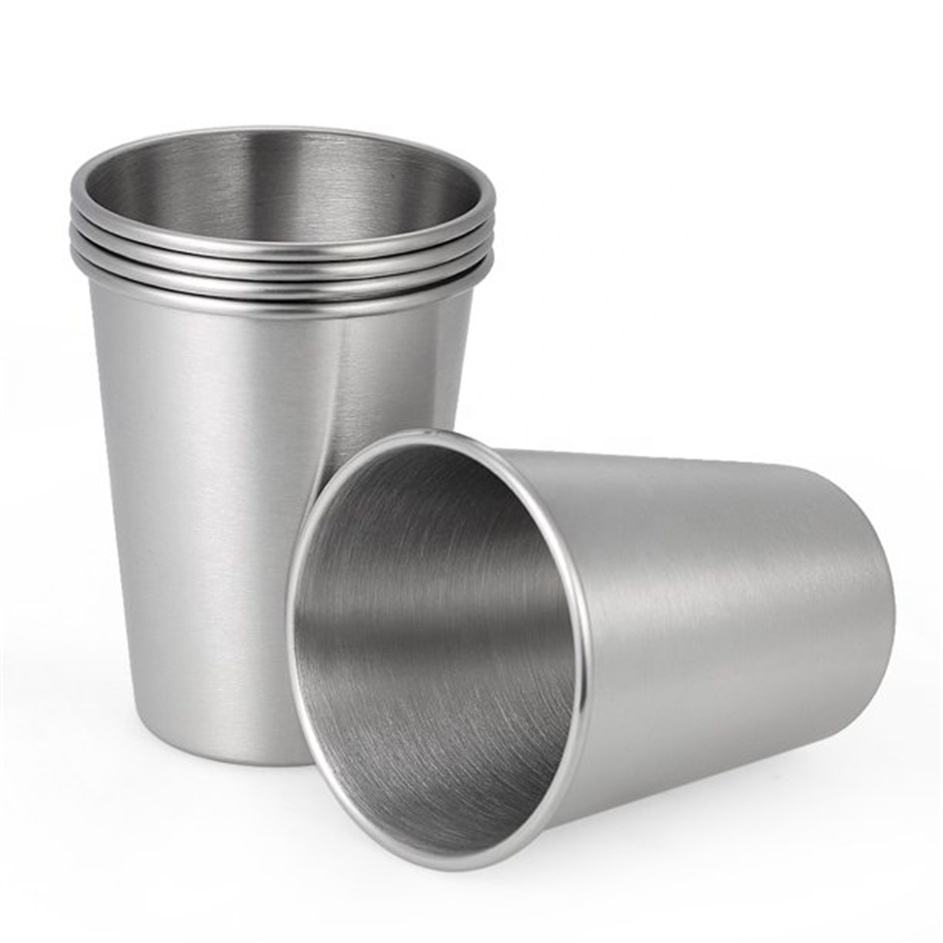
Typical deep drawn components include cylindrical components, stainless steel cups, deep drawn bowls and custom deep drawn parts. The production flow is: metal sheet material selection, precision stamping, deep drawing forming, trimming and edge finishing, surface treatment and quality inspection.
Key Differences at a Glance
- Part geometry — stamping produces flat or shallow formed parts; deep drawing produces hollow parts with depth, like cups and bowls.
- Material flow — stamping mainly cuts and bends; deep drawing stretches and flows the material into a cavity.
- Tooling — deep drawing tooling must manage material flow and thickness distribution; stamping tooling focuses on cutting and bending accuracy.
- Typical parts — brackets, clips, blade blanks, covers vs. cups, bowls, cylindrical housings, enclosures.
- Applications — stamping suits kitchen appliance, electrical and automotive components; deep drawing suits cookware, appliance bowls, housings and industrial parts.
Materials, Tolerances and Cost Considerations
Material choice affects both processes differently. Stainless steel, carbon steel and aluminum are all common stamping and deep drawing materials, but each behaves differently under forming. Deep drawing demands good ductility — the material must stretch without cracking as it flows into the die — while stamping places more emphasis on clean cutting and consistent bend behavior. During the project review, the manufacturer should confirm that the specified material grade supports the required depth and geometry of your part.
Tolerance control is another differentiator. Stamped features such as holes, slots and outer contours are defined directly by the tooling, while deep drawn dimensions are influenced by material springback and thickness distribution across the drawn wall. A serious supplier controls critical dimensions with precision measurement instruments and documents the results, so your assembly line never discovers a deviation late in the project.
Cost follows the process decision. Stamping tooling tends to be simpler for flat parts, and cycle times are fast. Deep drawing tooling is more complex because it must manage material flow across multiple draw stages for deeper parts. The right process — or combination — should be chosen on geometry and performance first, then optimized for cost with the manufacturer's input.
How to Choose: Stamping or Deep Drawing?
Choose stamping when…
- Your part is flat or has only shallow bends and forms.
- The part is cut from sheet — holes, slots, outlines — with simple 3D features.
- You need high-speed mass production of a consistent component.
Choose deep drawing when…
- Your part is hollow: a cup, bowl, canister or cylindrical body.
- The depth-to-diameter ratio requires material to flow into a cavity.
- The part must be seamless — drawn in one piece rather than welded or assembled from segments.
Many components sit in between. A food processor disc, for example, is primarily a stamped and formed part, while a juicer filter basket combines drawn and perforated structures. In practice, an experienced manufacturer can help you map your part geometry to the right process — or combine both in one project.
Why Choose a Manufacturer That Does Both?
When a single factory offers stamping, forming and deep drawing together — as Shengyue's manufacturing capabilities do — you avoid splitting one part across multiple suppliers. Tooling development, material selection, quality control and communication stay in one place, which simplifies project management and reduces risk.
Our production lines cover precision stamping, deep drawing and forming, tooling and mold making, secondary processing, surface treatment and cleaning, quality inspection and packaging. For new projects we support the full path from prototype to mass production, with custom tooling designed and developed in-house.
Next Step: Let Us Review Your Part
The fastest way to confirm which process fits your component is to send the drawing or sample. Our engineering team reviews the geometry, recommends the process route and returns a quotation with tooling and production details. Contact us or reach us on WhatsApp to start the review — there is no obligation and no cost for the initial project evaluation.