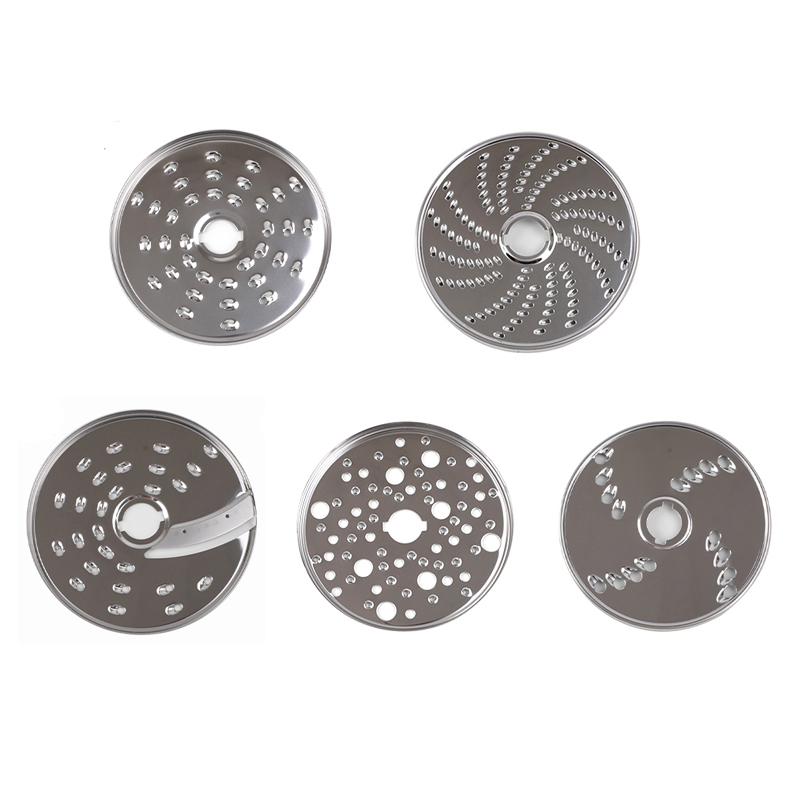
Food processor discs are what turn a simple motor unit into a versatile kitchen machine. One disc slices tomatoes, another shreds carrots, a third cuts julienne strips — all from the same base appliance. Each disc is a stamped stainless steel plate with dozens of precisely formed cutting edges, and its quality decides how evenly food is processed and how safe the tool is to use.
This guide covers the common disc types, why 420 / 430 stainless steel is used, how discs are manufactured, and what to define when sourcing them from an OEM supplier.
Why the Disc Is the Heart of a Food Processor
A food processor performs most of its functions through interchangeable discs. The blade patterns on each disc cut food as it is pressed against the rotating plate, and the result depends on edge geometry, hole layout and material hardness. Inconsistent edges produce uneven slices; soft material dulls quickly; sharp edges that are not formed correctly can be a safety concern in cleaning and handling.
Because these properties are invisible in a photo, buyers should evaluate the manufacturing process — stamping precision, edge forming and material selection — rather than judging from appearance alone.
Common Food Processor Disc Types
Food processor discs are produced in a range of patterns, each designed for a specific cutting task:
- Slicing discs — straight edges that cut even slices of vegetables, fruit and cheese.
- Shredding discs — tooth-like patterns that shred food into fine or coarse strands.
- Julienne discs — cutting edges arranged to produce thin matchstick strips.
- Custom processing discs — blade patterns developed to a brand's own recipe or a specific cutting result.
Disc diameter, center hub design and blade pattern must match the food processor model and its intended cutting tasks, which is why most projects start from a drawing, a sample or a confirmed reference disc.
Materials: Why 420 / 430 Stainless Steel
Food processor discs are manufactured from 420 and 430 stainless steel grades. These materials are specified for disc applications because they combine hardness for durable cutting edges with corrosion resistance and formability suitable for food-contact parts. The exact grade and hardness for your disc depend on the cutting task, expected service life and cost targets, and should be confirmed against your drawing during the project review.
At Shengyue Stamping, discs are produced from 420 / 430 stainless steel or a custom material agreed with the customer, with precision stamping and blade forming applied to the specification.
How Food Processor Discs Are Manufactured
The production flow is a combination of high-volume stamping and fine edge forming:
- Material preparation — 420 / 430 stainless steel sheet is selected and verified against the drawing.
- Precision stamping — the disc blank, holes and overall geometry are stamped with consistent tolerances.
- Hole & blade forming — cutting edges and perforation patterns are formed into the disc, defining the slicing, shredding or julienne function.
- Edge finishing — edges are finished for consistent cutting performance and safe handling.
- Surface treatment — polishing or a custom finish is applied where specified.
- Quality inspection — blade patterns, dimensions and surface quality are checked against the drawing before shipment.
High-volume stamping keeps blade patterns consistent across large production runs — important when a disc is sold as an accessory that must behave identically in every unit. For brands that sell discs as replacement parts or bundled accessory sets, this consistency is also what protects the brand experience: a customer's second disc must cut exactly like the first one that came in the box.
What You Can Customize in an OEM Disc Project
- Blade pattern — slicing, shredding, julienne or a custom pattern per your drawing.
- Size and shape — disc diameter and center hub matched to your food processor design.
- Surface treatment — polishing or custom finishes.
- Material — 420 / 430 stainless steel or custom material per project requirements.
Custom discs are developed from drawings or samples with in-house tooling support and a project review before production begins.
OEM Supplier Checklist for Food Processor Discs
- Stamping precision — high-volume stamping with consistent blade patterns and tolerances.
- Edge forming quality — how cutting edges are formed and finished, since this defines cutting performance.
- Material control — 420 / 430 stainless steel sourced with certificates and verified for composition.
- Inspection discipline — blade pattern, dimensions and surface checked against the drawing.
- Customization support — accepts drawings and samples, supports OEM / ODM development.
Our manufacturing capabilities and quality control pages describe how these areas are managed in practice.
Next Step: Send Your Drawing or Sample
Whether you need a slicing, shredding, julienne or custom disc, send us your drawing, sample or reference disc. Our team reviews the blade pattern, material and process route, and returns a quotation with tooling details. Contact us or reach us on WhatsApp to start the review.