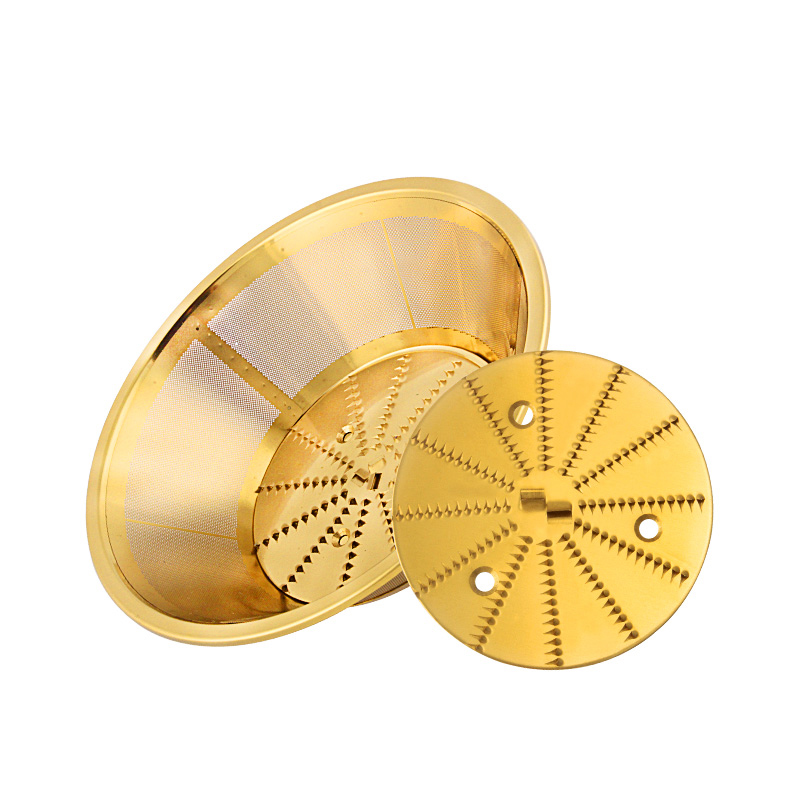
The filter basket is the component that determines how much juice a centrifugal juicer actually extracts — and how clean that juice is. It spins at thousands of revolutions per minute, separates pulp from liquid through thousands of microscopic holes, and must survive years of daily use and cleaning. Manufacturing it requires a rare combination of precision etching, deep drawing and welding expertise that few factories combine.
This guide explains how juicer filter baskets are made, why material and etching quality matter, and what to look for when sourcing them from an OEM manufacturer.
Why the Filter Basket Is a Critical Component
In a centrifugal juicer, the filter basket is the rotating sieve that shreds fruit and throws juice outward through its perforated wall. Its performance is defined by three things: the uniformity of the perforation pattern, the strength of the basket under high rotation speed, and the cleanliness of the juice it produces. Any irregularity — a blocked hole, a rough edge, a weak weld — shows up directly in juice yield, noise or durability.
These are not visible in a product photo. They depend on the manufacturing process, which is why brands that care about quality look beyond the sample and examine how the basket is actually produced. For a distributor or brand evaluating suppliers, understanding these process details is also the fastest way to tell a specialist manufacturer apart from a general metal stamping shop.
Material: Why SUS304 Stainless Steel
Juicer filter baskets are manufactured from SUS304 stainless steel — a grade chosen for its corrosion resistance, formability and suitability for food-contact applications. The material must withstand contact with acidic fruit juice without discoloration or corrosion, and it must form cleanly during deep drawing without cracking.
Material control starts before production: the supplier should use certified material and verify its chemical composition and mechanical properties. At Shengyue, the process begins with SUS304 food-grade stainless steel as the foundation for every basket we produce.
How Juicer Filter Baskets Are Manufactured
The production flow combines several precision processes in sequence:
- Material preparation — SUS304 food-grade stainless steel sheet is selected and verified.
- Precision chemical etching — the perforation pattern is created by chemical etching, which produces fine, uniform holes with burr-free edges — ideal for juice filtration.
- Deep drawing forming — the flat etched sheet is drawn into the basket's three-dimensional shape.
- Edge flanging — the rim is formed to create a strong, durable edge construction.
- Laser welding — seams are joined with laser welding for strength and a clean surface.
- Food safety inspection — every batch is checked against drawing tolerances before shipment.
Each stage is tied to the drawing, so the finished basket matches the approved specification hole by hole.
Why Chemical Etching Instead of Punching
Conventional punching can only produce holes down to a certain size, and punched holes often carry burrs that interfere with juice flow and are difficult to clean. Chemical etching creates much finer, uniformly spaced perforations with smooth, burr-free edges. For a filter basket, this means:
- Higher juice yield — more consistent open area across the basket surface.
- Cleaner juice — no rough edges to catch pulp or harbor bacteria.
- Design flexibility — hole size, shape and pattern are defined by the etching mask and can be tuned to your juicing performance targets.
Combined with deep drawing and laser welding, etching gives the basket both precise perforation and a durable edge structure — the two properties that matter most in service.
What You Can Customize in an OEM Filter Basket
- Basket size and shape — matched to your juicer's motor and housing design.
- Perforation pattern — hole size, spacing and pattern per your filtration requirements.
- Rim and edge design — flanging and seam construction per your assembly method.
- Finish — surface finish and cleaning-related details.
Custom baskets are developed from your drawing or sample, with in-house tooling support and project review before production.
OEM Supplier Checklist for Filter Baskets
- Etching capability — does the factory run precision chemical etching in-house, or is it outsourced?
- Forming depth — can they deep draw the basket shape and flange the edges reliably?
- Welding quality — is laser welding used, and are seams inspected?
- Material control — is SUS304 sourced with certificates and verified for composition?
- Inspection discipline — are perforation, dimensions and surface checked against the drawing before shipment?
- Custom design support — do they accept drawings and samples and support OEM / ODM development?
These capabilities are described in more detail on our manufacturing capabilities and quality control pages.
Next Step: Send Your Drawing or Sample
If you are developing a new juicer or sourcing replacement filter baskets, send us your drawing, sample or specification. Our team reviews the perforation pattern, material and process route, and returns a quotation with tooling details. Contact us or reach us on WhatsApp to start the review.