Robot lawn mowers have moved from a novelty to a mainstream category in garden equipment. With that growth comes a steady demand for replacement blades — small, precision-stamped parts that must be sharp, durable and consistent across millions of cutting cycles. For brands and distributors sourcing these blades, understanding the product and its manufacturing process is the difference between a reliable supply and a constant source of complaints.
This guide covers the blade types available, the materials used, how robot mower blades are made, and what to define when you send an RFQ to an OEM blade manufacturer.
Why Robot Mower Blades Are Different
Unlike the large steel blades of traditional lawn mowers, robot mower blades are small, lightweight and designed to spin at high speed in a protected cutting disc. They are treated as consumables — owners replace them periodically as the cutting edges wear. This creates a recurring demand pattern that favors products with:
- Consistent sharpness — edge quality that performs from the first cut to the last.
- Wear resistance — longer intervals between replacements, which directly affects owner satisfaction.
- Precise dimensions — a blade that does not fit the mounting pattern correctly is a safety and performance problem, not a cosmetic one.
- Repeatable quality — replacement batches must match the original specification exactly.
Common Robot Mower Blade Types
Replacement blades for robot mowers generally fall into three groups:
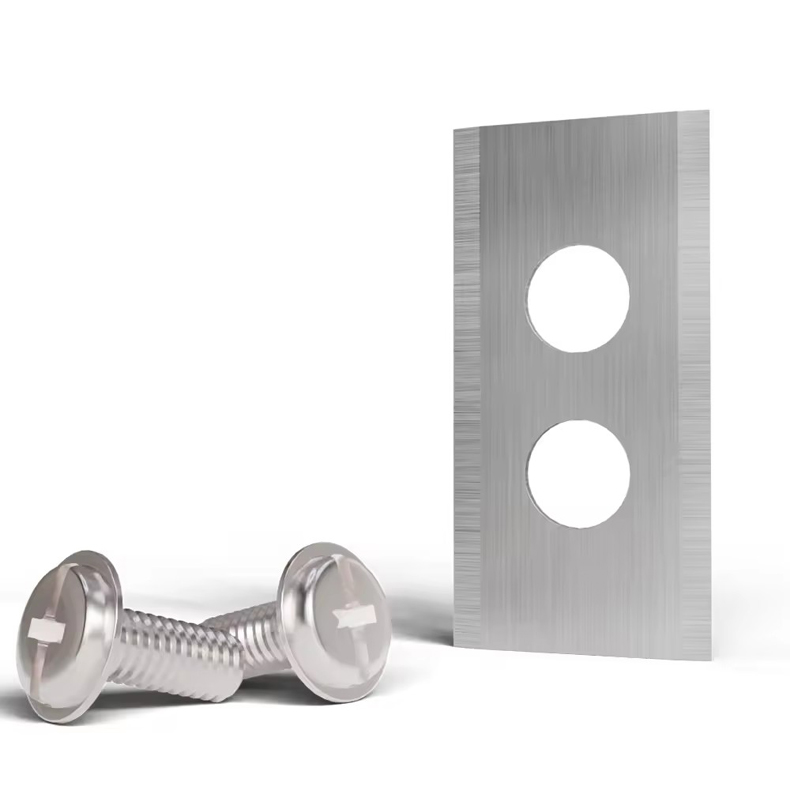
- Double-hole blades — a two-hole mounting design that provides strong fastening stability, used across many robot mower models.
- Single-hole blades — a lightweight blade with a single-hole design for fast, easy replacement.
- Custom blades — shapes, sizes and coatings developed to a brand's own specification or matched to a specific mower model.
Because the mounting pattern must match the cutting disc of each mower model, hole position, diameter and overall dimensions are critical. This is why most blade sourcing is done from a drawing, a sample or a confirmed reference model rather than a generic catalog.
Materials Used in Robot Mower Blades
Robot mower blades are typically manufactured from stainless steel or carbon steel, selected for the right balance of hardness, toughness and cost for the application. Stainless steel offers corrosion resistance for wet grass conditions, while carbon steel can be heat treated for higher edge hardness. The final choice depends on the cutting performance target, expected blade life and price point of the mower.
At Shengyue, blade material, shape, size and surface coating are all customizable according to your requirements. If your product uses a specific steel grade or a protective coating, it is confirmed during the project review before tooling begins.
How Robot Mower Blades Are Manufactured
The manufacturing process combines precision stamping with finishing operations that determine edge quality and durability:
- Material selection — the steel grade and sheet thickness are confirmed against the drawing and performance requirements.
- Precision stamping — the blade profile, holes and locating features are stamped with strict tolerance control.
- Heat treatment — where required, heat treatment adjusts hardness and toughness for the cutting application.
- Edge grinding — cutting edges are ground to a consistent, sharp geometry for clean and efficient cutting.
- Surface coating — a protective or decorative coating is applied where specified.
- Quality inspection — dimensions, edges and surface quality are checked against the drawing before shipment.
Each batch is verified against the approved first article, so replacement stock matches the original sample.
Key Specifications to Define in Your RFQ
To get an accurate quotation, specify the following on your drawing or in your inquiry:
- Blade dimensions — for reference, one confirmed Shengyue model is 36 × 18 × 1 mm; your model may differ.
- Hole diameter — for example Ø7 mm on the reference model.
- Fastener details — screw head size (approx. 9 mm on the reference model) and screw length (12.5 mm).
- Material and hardness — stainless steel, carbon steel or custom.
- Surface coating — specify if a coating or finish is required.
- Annual quantity — helps the supplier plan tooling and production capacity.
Full robot lawn mower blade specifications are available on the product page, and custom configurations are accepted from drawings or samples.
OEM Supplier Checklist for Replacement Blades
- Precision capability — high-precision stamping with strict tolerances on hole position and blade geometry.
- Process depth — stamping, heat treatment, grinding and coating under one roof simplifies quality control.
- Consistency program — first article approval plus in-process and final inspection for repeat orders.
- Customization support — accepts drawings and samples, supports OEM / ODM from design to mass production.
- Material expertise — can discuss steel grades and coatings for your cutting performance targets.
For a broader view of how a stamping partner manages these areas, see our manufacturing capabilities and quality control pages.
Next Step: Send Your Blade Drawing or Sample
Whether you need a replacement blade for an existing mower model or a custom blade for a new product, the starting point is the same: send us the drawing, sample or reference model. Our team reviews the specification, confirms material and process options, and returns a quotation. Contact us or reach us on WhatsApp to discuss your robot lawn mower blade project.