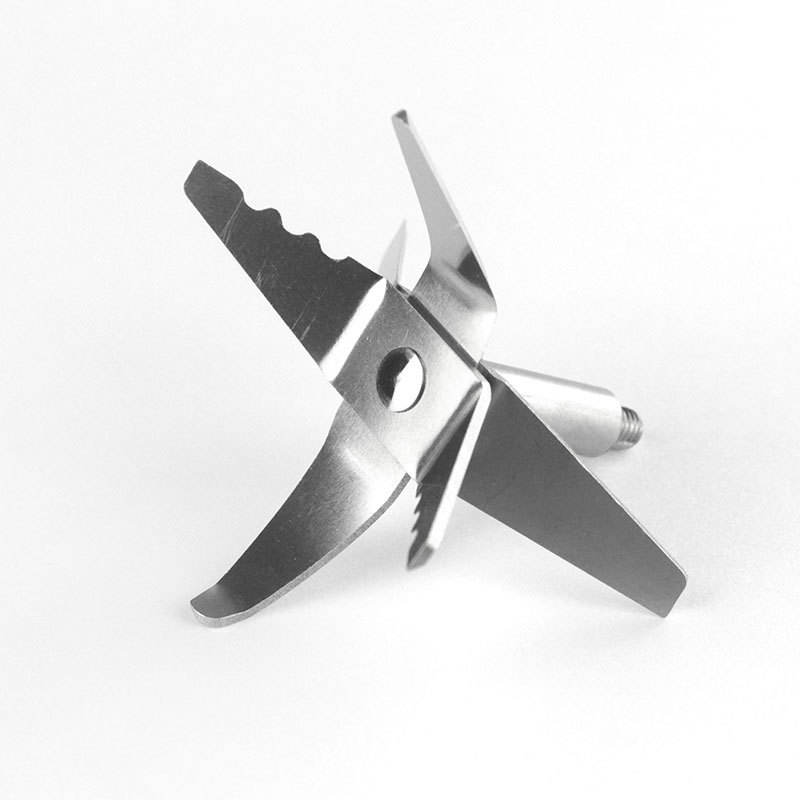
The blender blade is one of the most critical components in any blending appliance. It determines cutting performance, durability, noise level and ultimately how well the product performs in the hands of end users. For appliance brands, sourcing a reliable OEM blade supplier is therefore not a purchasing task — it is a product quality decision.
This guide explains how blender blades are manufactured, what you can customize, and how to evaluate an OEM supplier before sending your drawing or sample.
Why OEM Blade Sourcing Deserves Careful Attention
Blender blades are exposed to high rotational speed, continuous impact and abrasive food ingredients. Small deviations in material, edge geometry or heat treatment can cause premature dulling, vibration or even safety issues. Because the blade is a stamped and formed metal part, its quality depends heavily on the manufacturer's tooling, process control and inspection discipline — all of which are difficult to assess from a product photo alone.
Working with a manufacturer that supports custom blender blade manufacturing from drawings or samples gives your brand control over blade shape, size, thickness and finish, rather than being limited to off-the-shelf designs.
Common Blender Blade Types
Blender blades are produced in a wide range of designs depending on the application. Typical configurations include:
- Straight-edge blades — general-purpose cutting for everyday blending tasks.
- Serrated blades — improved chopping performance for fibrous or harder ingredients.
- Custom-edged designs — blade edge geometry developed to match a specific performance target or brand requirement.
Beyond edge type, blades are customized for different appliances: standard blenders, food processors, portable blenders and commercial blenders all use different blade sizes, hole patterns and shaft configurations. A capable OEM supplier should be able to produce all of them from your drawing or an existing sample.
Materials Used in Blender Blades
Stainless steel is the dominant material for blender blades because of its corrosion resistance, strength and suitability for food-contact applications. Within a project, the exact grade is selected based on the blade's hardness, toughness and cost requirements, and the material should always be agreed between the buyer and the manufacturer before tooling begins.
At Shengyue Stamping, blade material, blade edge, center hole or shaft design, size, thickness and surface treatment can all be customized according to the drawing or sample supplied by the customer. If your project needs a specific stainless steel grade or a custom finish, it is discussed during the project review before production starts.
How Blender Blades Are Manufactured
A typical OEM blender blade production flow combines several metalworking operations:
- Stamping — the blade blank is cut from stainless steel sheet using precision stamping tooling. This establishes the overall blade shape and any locating holes in a fast, repeatable operation.
- Forming — the blade is bent or formed to its final three-dimensional geometry, such as the twisted or angled cutting sections that create the vortex in a blender jar.
- Grinding — cutting edges are ground to achieve the required sharpness and edge consistency.
- Assembly — where required, the blade is assembled with shafts, bushings or other components before packaging.
Every stage is accompanied by process inspection. From incoming material inspection to dimensional and surface checks, the goal is to ensure every blade in the production run matches the approved first article.
What You Can Customize in an OEM Blade Project
- Blade design — shape, size and thickness per your drawing or sample.
- Edge type — straight, serrated or custom edge geometry.
- Center hole / shaft — matched to your motor coupling and jar assembly.
- Surface treatment — polishing or custom finishes.
- Material — stainless steel or custom material per project requirements.
Blender Blade Supplier Checklist
When evaluating an OEM blade manufacturer, use the following checklist as a starting point:
- Tooling support — does the manufacturer develop tooling in-house for new blade designs?
- Custom design acceptance — will they work from your drawing or sample rather than pushing a standard catalog part?
- Process coverage — can they handle stamping, forming, grinding and assembly in one place? Fewer handoffs means easier quality control.
- Quality control system — ask how incoming material, first article, in-process and final inspections are handled.
- Response speed — how quickly do they evaluate a project and return a quotation?
- OEM cooperation model — do they support long-term OEM supply, sample development and staged delivery?
For more detail on these capabilities, review our manufacturing capabilities and quality control pages.
Next Step: Send Your Drawing or Sample
Every custom blade project starts with a drawing, sample or a clear set of requirements. Once we receive it, our team evaluates the design, confirms material and process options, and provides a quotation. Whether you need a single prototype or mass production, the starting point is the same — contact our team or reach us on WhatsApp to discuss your blender blade project.