Should you sharpen a worn lawn mower blade or replace it? The answer depends on more than whether the cutting edge feels dull. A blade with minor edge wear may be serviceable, while a blade with cracks, bending, excessive material loss or a damaged mounting hole should be replaced rather than ground further.
Questions about sharpening, balance and replacement recur in lawn-care discussions. For OEM buyers, the same concerns point to manufacturing requirements: reliable blade geometry, controlled material properties and repeatable fit across production batches.
Quick Decision Guide: Sharpen or Replace?
| Blade condition | Recommended action | Reason |
|---|---|---|
| Evenly dulled edge; blade otherwise intact | Sharpen according to mower manufacturer guidance | Restores the intended cutting edge without unnecessary replacement |
| Minor nicks within service limits | Inspect, then sharpen if permitted | Small defects may be removable without excessive material loss |
| Cracks, bends or damaged mounting features | Replace | Structural or fit damage can create a safety risk |
| Severe chips, heavy erosion or substantial material loss | Replace | Further grinding may compromise geometry, strength or balance |
| Persistent vibration after correct installation | Stop use and inspect the entire assembly | Possible blade imbalance, mounting problems or other machine faults |
Always follow the equipment manufacturer's inspection and replacement limits. Do not attempt to straighten cracked or bent blades, and disconnect the machine's power source before maintenance.
Why Dull Blades Affect Cutting Quality
A dull cutting edge can tear grass instead of producing a clean cut. But poor cutting quality is not proof that the blade alone is defective: deck condition, speed, grass moisture and mower setup also affect results. Inspect the blade rather than relying only on the appearance of the lawn.
Blade Balance: Why It Matters
Grinding removes metal. If material is removed unevenly, the blade may become unbalanced, causing vibration and added loads on the spindle or bearings. A simple static balance check can reveal gross imbalance, but it does not replace the equipment manufacturer's procedures or prove dynamic balance in the installed system.
For blade suppliers, consistent blanking, hole location, edge processing and controlled part mass help reduce variation. An OEM specification should define the required balance or mass-distribution acceptance method where applicable, rather than assuming every blade has the same test requirement.
What Causes Early Blade Wear?
- Abrasive contamination: sand, soil and debris accelerate edge wear.
- Impact damage: stones and hard objects may chip or bend the blade.
- Material and heat-treatment selection: hardness, toughness and corrosion resistance must suit the actual operating environment.
- Edge geometry: angle, finish and burr condition influence initial performance and serviceability.
- Operating conditions: mowing frequency, grass type and moisture affect maintenance intervals.
Traditional Mower Blades vs Robot Mower Blades
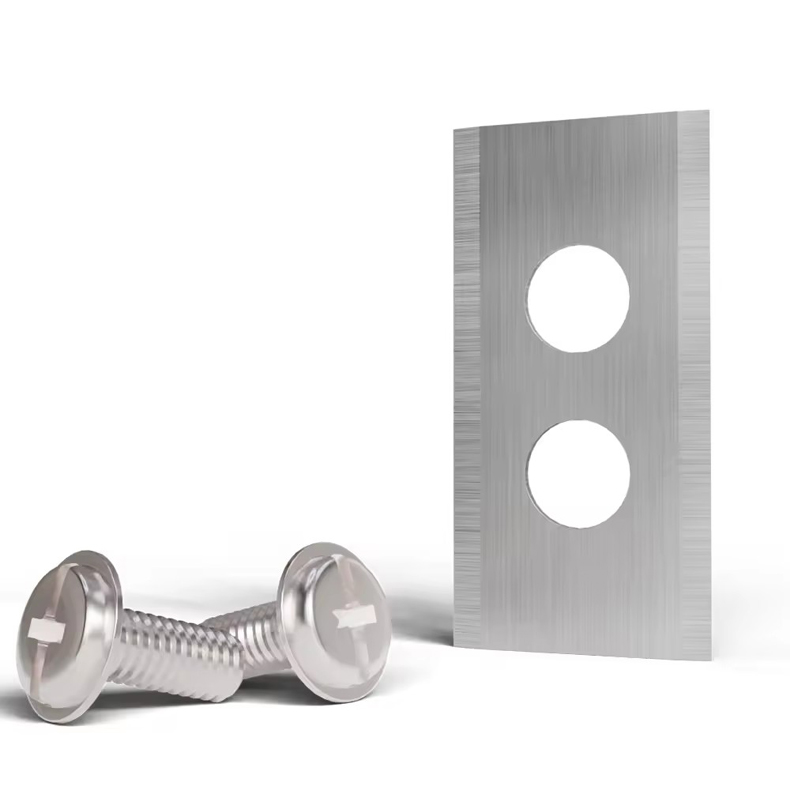
Conventional rotary mowers commonly use a relatively large fixed blade. Many robotic mowers instead use small replaceable blades attached to a rotating disc. Their mounting systems, wear patterns and replacement instructions differ. A sharpening recommendation for a large conventional blade should never be applied automatically to a small robotic mower blade. Follow the specific manufacturer's instructions.
Brands sourcing compact replacement blades can review our robot lawn mower blade manufacturing page and the related robot mower blade materials and OEM guide.
OEM Blade Manufacturing: Five Details to Specify
- Blade drawing and compatibility: overall profile, thickness, mounting hole geometry and tolerance requirements.
- Material specification: grade, condition and any required corrosion-resistance or mechanical-property tests.
- Edge requirements: cutting angle, edge finish, permitted burrs and acceptance criteria.
- Post-processing: any required heat treatment, coating, cleaning and packaging.
- Inspection plan: dimensional checks, edge inspection, traceability and any agreed functional or balance tests.
Material grades and hardness targets should be selected and verified against the application; no single steel grade or hardness value is universally best for every mower design. For additional guidance on preparing drawings and acceptance criteria, see our custom metal parts RFQ guide and quality overview.
Questions OEM Buyers Frequently Ask
Can a dull mower blade always be sharpened?
No. Sharpening is only appropriate when the blade is structurally sound and remains within the mower manufacturer's service limits.
Does static balancing guarantee safe operation?
No. It is one check, not a substitute for proper installation, inspection and the manufacturer's operating requirements.
Can replacement blades be manufactured from a sample?
A sample can support feasibility review, but a confirmed drawing, compatibility requirements and agreed inspection criteria are important before mass production.
What should a blade RFQ include?
Send the drawing or sample, target quantity, material preference, surface treatment, compatible mower model and any relevant tests or certifications.
Request an OEM Blade Review
Shengyue supports custom stamped metal cutting components for OEM projects. Share your technical drawing or sample for a manufacturing feasibility discussion and quotation. Contact our team to discuss your blade requirements.
Research inspiration: discussions in r/lawncare on sharpening versus replacement and r/lawnmowers on balance checks. Community posts are used to identify questions, not as engineering test evidence.