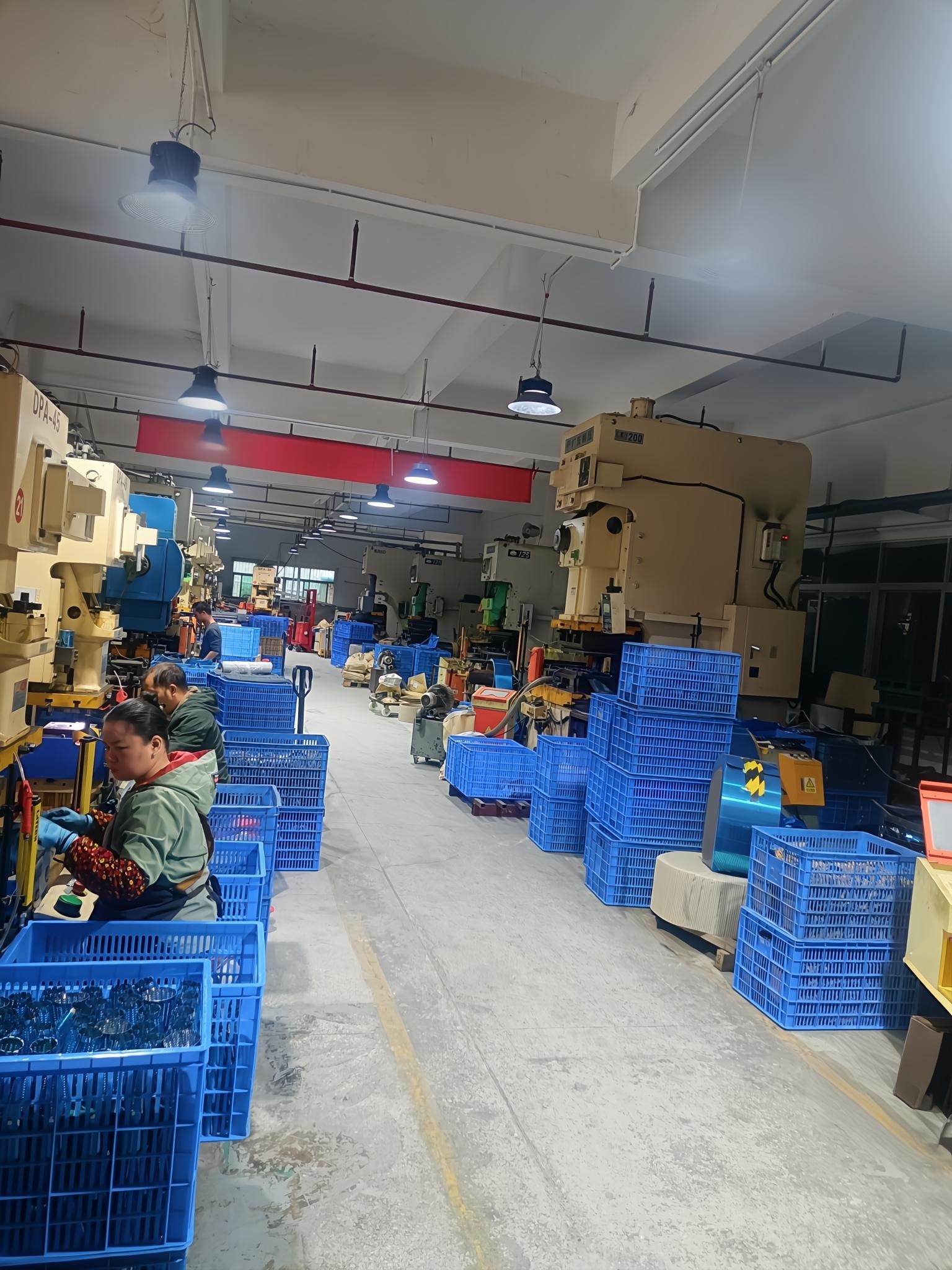
Should an OEM buyer choose progressive die stamping or a single-stage stamping process? The right answer depends on part geometry, expected production volume, tooling budget, tolerance requirements and the cost of secondary operations. Neither approach is automatically the lowest-cost choice for every project.
This guide compares the two production approaches and shows what information to request from a stamping supplier before approving tooling. It is intended for appliance, food-processing and industrial component sourcing teams.
Progressive Die vs Single-Stage Stamping: Quick Comparison
| Decision factor | Progressive die stamping | Single-stage stamping |
|---|---|---|
| Process | Multiple operations at successive stations as strip advances through one die | One main operation per press stroke or setup; additional steps may use separate tools |
| Tooling investment | Often higher due to integrated tooling and development complexity | Often lower for simple parts, but extra operations add tooling and handling costs |
| Production volume | Can be attractive for stable, repeatable higher-volume demand | Can be attractive for prototypes, lower volumes or simpler geometries |
| Unit cost | Can decrease at sufficient volume through reduced handling and faster production | May be competitive at modest volumes; separate operations can increase labor |
| Design changes | Changes can affect several stations and require substantial die rework | Some changes may be easier to isolate, depending on tooling |
| Quality considerations | Requires control of strip progression, station alignment, tool wear and scrap | Requires control of setup, transfer, positioning and consistency between steps |
These are general trade-offs, not guaranteed outcomes. Actual cycle time, yield, material utilization and tooling costs must be quoted against the same drawing and production assumptions.
1. What Is Progressive Die Stamping?
In progressive die stamping, a metal strip passes through multiple tool stations. Each station performs part of the manufacturing sequence, such as piercing, notching, forming or blanking. The part remains connected to the strip until a designated cutoff step, depending on the design.
For suitable components, progressive tooling can consolidate operations and reduce intermediate handling. The design must account for strip layout, carrier strength, feed accuracy, part orientation and the ability to maintain dimensions across stations.
2. What Is Single-Stage Stamping?
A single-stage operation performs one primary operation in a press setup, such as blanking or bending. More complex parts may require several separate operations, fixtures or presses. This approach can be practical when production demand is uncertain, part geometry is straightforward or the buyer expects design revisions.
Single-stage does not mean low quality or manual production. The required controls depend on the operation, equipment, fixtures and inspection plan.
3. How Production Volume Changes the Economics
Tooling is generally a fixed upfront investment, while material, press time, labor, scrap and finishing contribute to the recurring cost per part. A higher-cost progressive tool may become economical over a large production run if it reduces recurring processing cost.
Illustrative calculation only: if Option A has a tooling cost of $18,000 and a variable cost of $0.28 per part, while Option B has a tooling cost of $5,000 and a variable cost of $0.54 per part, their simplified cost crossover is:
($18,000 − $5,000) ÷ ($0.54 − $0.28) = 50,000 parts.
These figures are hypothetical, not a SHENGYUE quotation. Real comparisons should also consider scrap, maintenance, packaging, inspection, revisions, lead time and the buyer's forecast reliability.
4. Design for Manufacturing (DFM) Questions
- Material and thickness: specify the exact grade, temper and acceptable thickness variation.
- Hole and slot geometry: identify critical hole sizes, spacing and edge distances.
- Bend features: review bend radius, springback, grain direction and nearby cutouts.
- Strip layout: assess material utilization, carrier design and scrap removal for progressive tools.
- Critical tolerances: distinguish assembly-critical dimensions from general dimensions.
- Surface requirements: identify cosmetic faces, burr direction and finishing requirements.
Review our stamping tooling development guide and stamping defects and burr control guide for related design and quality considerations.
5. What to Compare in Supplier Quotations
| Quotation item | What the OEM buyer should request |
|---|---|
| Tooling scope | Die type, number of operations, included fixtures, maintenance assumptions and tool ownership |
| Production pricing | Unit price at multiple annual volumes, including material, scrap and secondary operations |
| Sampling and approval | Prototype or first-article samples, inspection report and approval milestones |
| Capacity and lead time | Tooling lead time, production capacity, standard batch size and replenishment lead time |
| Quality controls | Critical dimensions, edge quality, inspection frequency and traceability expectations |
| Change management | Process for engineering changes, die modifications and revision approval |
| Packaging and logistics | Part protection, carton quantity, shipping terms and destination |
Request both tooling and unit pricing so proposals can be compared on a consistent total-cost basis. Our custom metal parts RFQ guide
6. A Practical Supplier Selection Workflow
- Share the drawing: provide revision-controlled drawings, material specification, volumes and critical features.
- Ask for process alternatives: invite suppliers to explain why progressive or separate operations fit the part.
- Compare total cost: evaluate tooling plus expected lifetime production, not unit price alone.
- Approve samples: validate dimensions, appearance, assembly fit and required testing before production.
- Agree on controls: document inspection, tool maintenance, traceability and change approval.
Frequently Asked Questions
Is progressive die stamping always cheaper?
No. It may reduce recurring unit costs for suitable high-volume parts, but higher tooling investment can outweigh those savings at low volumes or when designs change frequently.
Can a progressive die make complex formed parts?
Many parts can combine cutting and forming operations in one progressive tool. Feasibility depends on geometry, material flow, strip support, tolerances and press capacity.
Which approach is better for prototypes?
For early design validation, simpler tooling or separate operations may reduce upfront investment. The best method depends on the features being tested and whether the prototype must represent production tooling.
What information is needed for a stamping tooling quote?
Send 2D/3D drawings, material and thickness, tolerance requirements, expected annual quantity, order lot size, finish, sample requirements and delivery destination.
Request an OEM Stamping Process Review
SHENGYUE supports custom stamped metal parts and tooling discussions for OEM projects. Send your part drawing and expected volumes so our team can review feasible manufacturing approaches and prepare a project-specific quotation. Explore our product range and manufacturing capabilities.