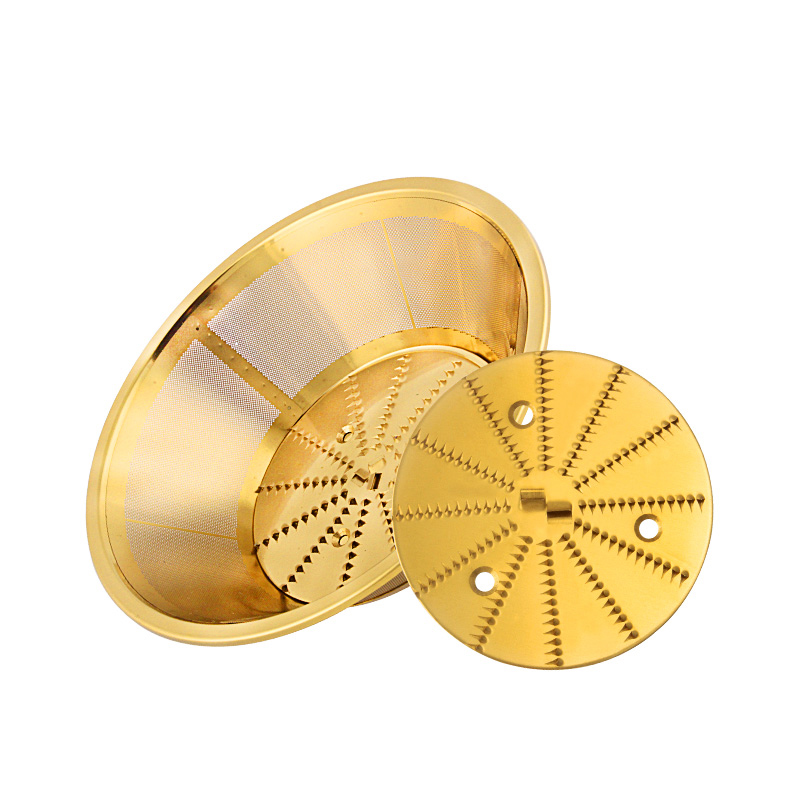
Walk through the product pages of any kitchen appliance parts supplier and you will meet the same three names: SUS304, 420 and 430 stainless steel. They appear on juicer filter baskets, blender blades, food processor discs and countless other stamped components. But what actually differs between them — and which one should your part use?
This guide explains how these grades are typically applied in kitchen appliance manufacturing, based on real production configurations, and what to specify when you send a drawing to a stamping supplier.
The Three Grades You Will See Most Often
SUS304 (Austenitic Stainless Steel)
SUS304 is the workhorse of food-contact components. It offers strong corrosion resistance, good formability and reliable performance in contact with food and cleaning agents. Because of this combination, it is commonly specified for parts that hold or filter food — a typical example is the juicer filter basket, which is manufactured from SUS304 food-grade stainless steel at Shengyue.
420 (Martensitic Stainless Steel)
Grade 420 belongs to the martensitic family of stainless steels, which are known for their ability to be hardened by heat treatment. Hardened cutting edges retain sharpness longer, which is why 420 is a common choice for blade-type components such as food processor discs.
430 (Ferritic Stainless Steel)
Grade 430 is a ferritic stainless steel offering good corrosion resistance at a more economical cost point. It forms cleanly and is widely used in appliance parts where the corrosion demands are moderate — food processor discs are commonly produced from 420 / 430 stainless steel.
How Grades Map to Real Components
Across our product lines, the material selection follows the part's function:
- Juicer filter baskets — SUS304 food-grade stainless steel, for corrosion resistance in contact with acidic fruit juice and frequent cleaning.
- Food processor discs — 420 / 430 stainless steel, balancing edge hardness for cutting with economical formability.
- Blender blades — stainless steel with the exact grade selected per project, or a custom material agreed with the customer.
- Robot lawn mower blades — stainless steel or carbon steel depending on the hardness and cost targets.
These configurations are not arbitrary — each grade is chosen for the balance of corrosion resistance, hardness, formability and cost that fits the part's job.
Key Trade-offs at a Glance
- Corrosion resistance — SUS304 generally leads in food-contact environments; 430 is solid for moderate duty; 420 is selected when edge hardness matters more than maximum corrosion performance.
- Hardness — martensitic 420 can be heat treated for harder cutting edges, which is why blade-type parts favor it.
- Formability — austenitic and ferritic grades form well for stamped and deep drawn geometries.
- Cost — grade choice affects material cost; the right grade for the job avoids paying for properties you do not need.
These are general engineering trade-offs. The final decision should always be validated against your drawing, testing requirements and cost targets with the manufacturer.
Why the Grade Must Be Confirmed Early
Material choice is not a detail that can be fixed later. It affects tooling design, forming behavior, heat treatment steps and unit cost — changing the grade after tooling is built can mean reworking dies and re-qualifying the part. That is why the grade should be confirmed during the project review, before tooling development begins, and why suppliers with in-house material knowledge add real value at this stage. A good manufacturer will push back if the specified grade does not suit the part geometry, rather than silently proceeding.
What to Specify in Your RFQ
To get the right part at the right price, state the material clearly on the drawing or in your inquiry:
- Exact grade — e.g. SUS304, 420, 430, or a custom material; avoid writing only "stainless steel" if the grade matters.
- Hardness requirement — if the part is a blade, specify whether hardness after heat treatment is required.
- Thickness — sheet thickness affects both performance and forming behavior.
- Surface finish — polished, brushed, passivated or other requirements.
Suppliers should verify material certificates and chemical composition before production. Our quality control process includes incoming material inspection with material certificates for every project.
Choosing the Right Grade: A Simple Decision Path
- If the part contacts food and needs maximum corrosion resistance → start the conversation with SUS304.
- If the part is a cutting blade that must stay sharp → ask about 420 with heat treatment.
- If the part needs good corrosion resistance at a moderate cost → evaluate 430.
- If in doubt → send the drawing and let the manufacturer's engineering team recommend a grade with justification.
For examples of how these grades appear in real products, browse our product pages or read our guides on juicer filter basket manufacturing and food processor discs.
Next Step: Send Your Drawing with the Grade Specified
The fastest way to confirm the right material for your part is to send the drawing or sample with your performance requirements. Our team reviews the application, confirms the grade and process route, and returns a quotation. Contact us or reach us on WhatsApp to start the review.